
Why Support Leaders Should Pair AI Deflection with Human Support

Are you enjoying talking to the AI bot when trying to reschedule your flights or when your food delivery has gone wrong and you immediately want a replacement? Are you excited knowing you are going to get tuned into an AI bot when you have a customer deployment pending and are running into development challenges? If YES, this post is definitely NOT for you, but for the most of us who crave solutions quickly, read on....
Support teams are often asked to solve more problems with existing or fewer resources. AI deflection helps manage the load by resolving routine issues automatically,password resets, order status, basic FAQs,so human agents can focus on harder problems. In many forward-leaning organizations, ticket deflection with AI reaches 60–75%, meaning six out of ten support requests never need human intervention. This reduces ticket volume while preserving or even improving customer satisfaction. (MatrixFlows, Build AI Agents That Reduce Support Tickets 60%)
Deflection doesn’t just improve efficiency. It also creates breathing room for scaling without immediate headcount increases. AI tools (chatbots, knowledge bases, virtual agents) can be deployed faster and cost far less over time than hiring multiple full-time agents for high-volume tasks.
Despite all the advancements, customers still prefer human support under certain conditions. According to an InMoment study, 81% of customers rely on direct interaction with a human when issues are serious or complex. Quick, accurate resolution and empathy often matter more than speed when stakes are high. (InMoment, Consumers want real human support). In my personal opinion consumer behavior and demands, very quickly, bleed into the B2B world - they always have.
Expectations around response times are higher than ever. FluentSupport reports that 90% of customers say a rapid response , sometimes meaning within minutes , significantly impacts their perception of the company. Delays drive down loyalty even if the issue eventually gets resolved. (Fluent Support Statistics 2025)
Best-in-class support orgs are combining AI deflection and human support. This hybrid model preserves operational efficiency while maintaining,or improving,customer loyalty.
Key components of the hybrid approach:
- AI handles the predictable: automation and virtual agents resolve or triage routine, high-volume tickets. Example: ServiceNow virtual agents reduce resolution times by up to 60% for common IT or access issues. (LMTeq, Accelerate Ticket Resolution by 60%)
- Humans handle edge cases: escalation paths should be fast for complex queries, emotionally charged cases, or where nuance and trust matter.
- Measure both sides: track deflection rate, cost per ticket, first response time, CSAT, NPS, and also sentiment for escalations.
For leaders balancing efficiency with empathy, there’s also the question of cost. In the U.S., a fully loaded support rep can run $90K–$120K annually PLUS benefits, payroll, taxes, etc. At Exordiom Talent, organizations are able to add three to four experienced offshore support professionals for the cost of one U.S. rep. That kind of leverage means AI deflection savings don’t just disappear into overhead,they’re reinvested into human headcount where it matters most, giving teams the scale to support customers without sacrificing quality.
The hybrid model demands customer support reps who become a combination of AI agent managers in support and experts in managing edge cases through playbooks created internally to provide a personalized customer experience and a solution.
- High-deflection AI can reduce ticket volume by 60%, but the cost savings are amplified when reinvested into affordable human headcount(Netlify's Playbook). Leaders working with Exordiom Talent typically see 70% lower spend while expanding coverage 3–4x compared to U.S. staffing alone.
- When customers still need human help, speed matters: deflection may reduce ticket load, but studies show 72% of customers expect immediate service in many SaaS support contexts.
- Loyalty is fragile. Brands offering excellent service see repeat purchases increase dramatically. Conversely, negative experiences, especially when customers feel ignored or forced to go through cumbersome AI systems, lead to higher churn and lower referral rates. (Fluent Support: 83% loyalty when support resolves complaints well)
Support leaders aiming to scale support sustainably should consider these steps:
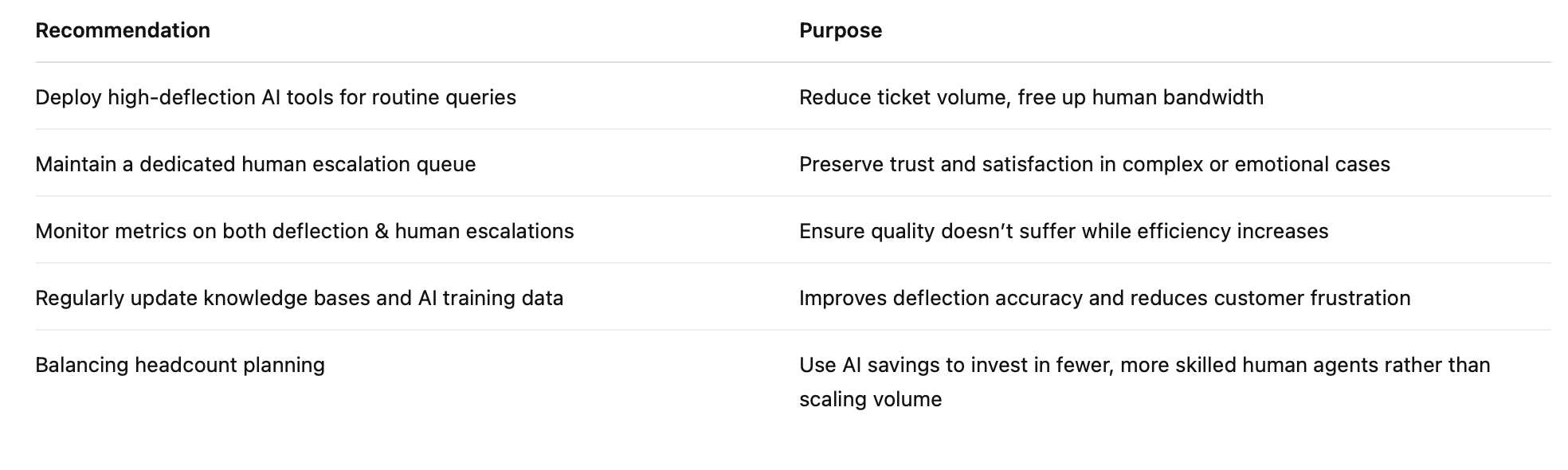
Efficiency doesn’t have to come at the cost of empathy. We're seeing across our customer base that the best customer support leaders build systems that balance both. AI deflection for what can be automated, human support where it matters. Customers notice the difference , especially when help arrives from someone who listens.
Support orgs that master this balance will scale faster, save resources, and hold customer trust , the kind that earns renewals and referrals. It's exactly the same feeling you get when you get off a customer support call and feel like sharing the extra few words of your gratitude that the support rep was able to solve your issue.
Access the talent you can't find locally at a fraction of the cost. Deploy in 10 days. Scale without limits